
The Great Creative Refocus: Why Artists are Leaving Megacities for the Middle
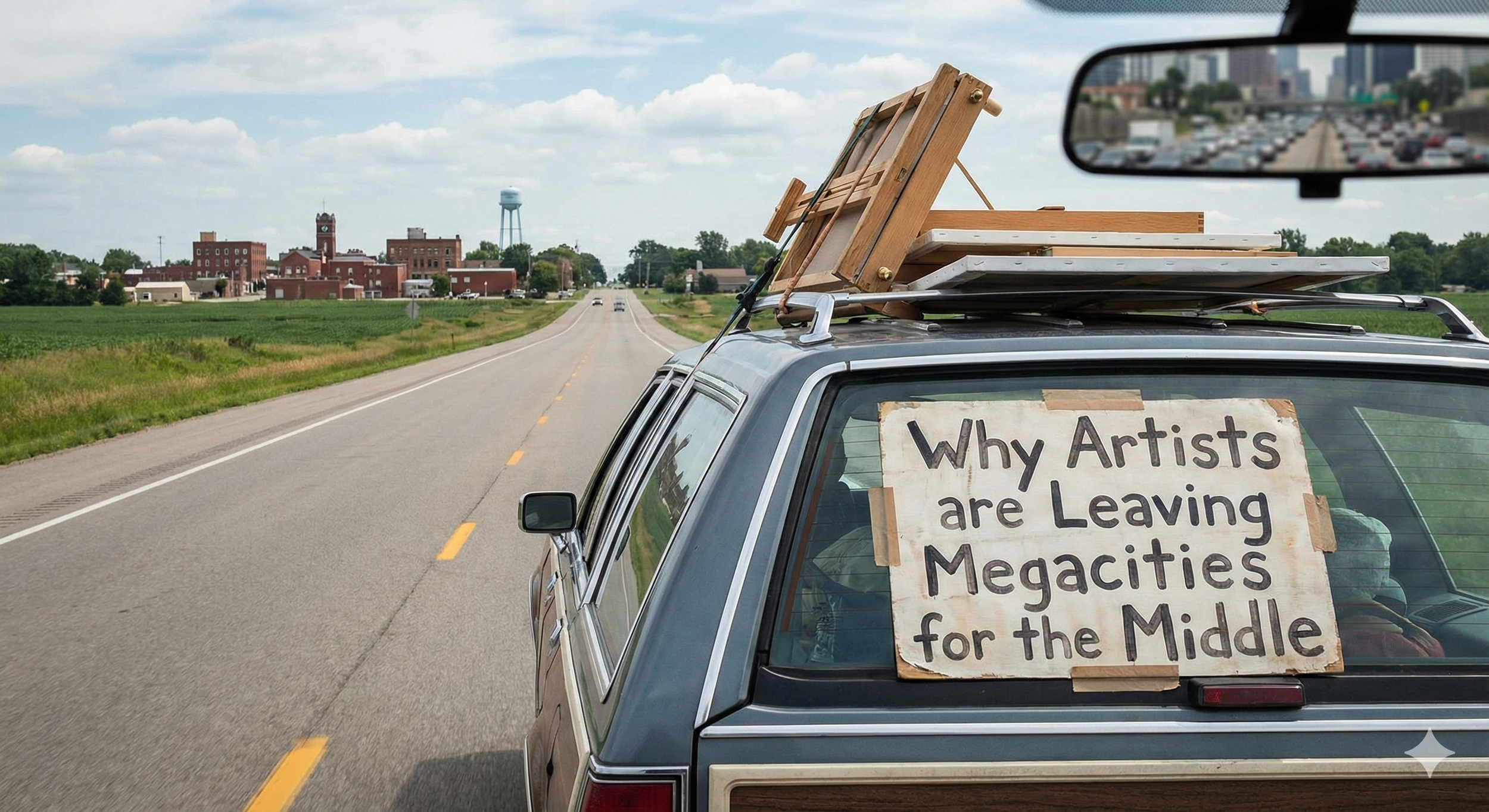
“Erie stands at the threshold of a new era, where geography is no longer a cage, but a connection. By providing the tools of the future within the architecture of the past, we are doing more than just revitalizing a city; we are building a sanctuary for the next American Renaissance.
Let the artists create the path, and the entrepreneurs build the bridges that make that path a permanent highway for progress.”
For decades, the narrative of the creative professional was inextricably linked to the skyline of a megacity. To "make it," one had to endure the stratospheric rents of Brooklyn, the cutthroat competition of Los Angeles, or the cramped studios of San Francisco. However, as we move through 2025, a quiet tectonic shift is occurring. The "Creative Class"—a demographic of artists, designers, and innovators—is beginning a mass migration. This is not merely a flight from high taxes; it is a fundamental re-evaluation of what it means to live a creative life. For smaller, mid-sized cities, this "Creative Exodus" represents a once-in-a-generation opportunity to revitalize their local economies and redefine their cultural identities.
The primary driver of this migration is the collapse of the "bohemian" lifestyle in major hubs due to extreme cost-of-living increases. In 2025, median mortgage payments and rents in coastal hubs have reached levels that demand a corporate salary, leaving little room for the financial instability inherent in creative pursuits. For a painter or an indie musician, these numbers act as a hard stop to production. Furthermore, the "digital decoupling" of work—accelerated by high-speed satellite internet and mature remote collaboration tools—has removed the geographical tether that once kept talent anchored to expensive urban cores. A graphic designer in Asheville can now collaborate with a client in Manhattan as seamlessly as if they were in the same zip code.
Smaller cities like Richmond, Virginia, and Wichita, Kansas, are no longer viewed as "consolation prizes" for those who could not succeed in New York. Instead, they are being sought out for their specific "pull" factors: sustainable living and civic impact. Lower costs do not just mean more space; they mean a reduction in "hustle culture," allowing artists to work fewer hours for survival and more hours for pure creative exploration. Additionally, in a smaller city, a creative individual can become a foundational pillar of the community, influencing local zoning laws or starting festivals that define the city's brand, rather than being just one of tens of thousands in a saturated market.
To successfully leverage this exodus, smaller cities must move beyond offering cheap rent and prioritize the development of "Third Spaces." These are communal areas such as makerspaces, public plazas, and collaborative studios that foster the organic mentorship found in major hubs. Cities that implement artist-specific zoning—such as live-work permits for historic industrial buildings—can prevent the "gentrification trap," where artists revitalize a neighborhood only to be priced out of it years later. By providing micro-grants and investing in digital infrastructure, mid-sized municipalities can transform themselves into specialized hubs for niche industries like sustainable fashion or digital media.
The economic impact of this migration is measurable and profound. When a "creative cluster" forms in a smaller city, it creates a ripple effect: artists attract galleries, which attract hospitality and retail, which eventually attracts tech-focused investors and a highly educated workforce. Research indicates that job growth rates are often twice as high in "creative-class" counties than in those reliant on traditional industries. As megacities continue to struggle with housing crises and infrastructure strain, the redistribution of talent to the "middle" of the country promises to make the national cultural landscape more resilient, diverse, and accessible than ever before.
The Pennsylvania Nexus: Erie’s Strategic Emergence
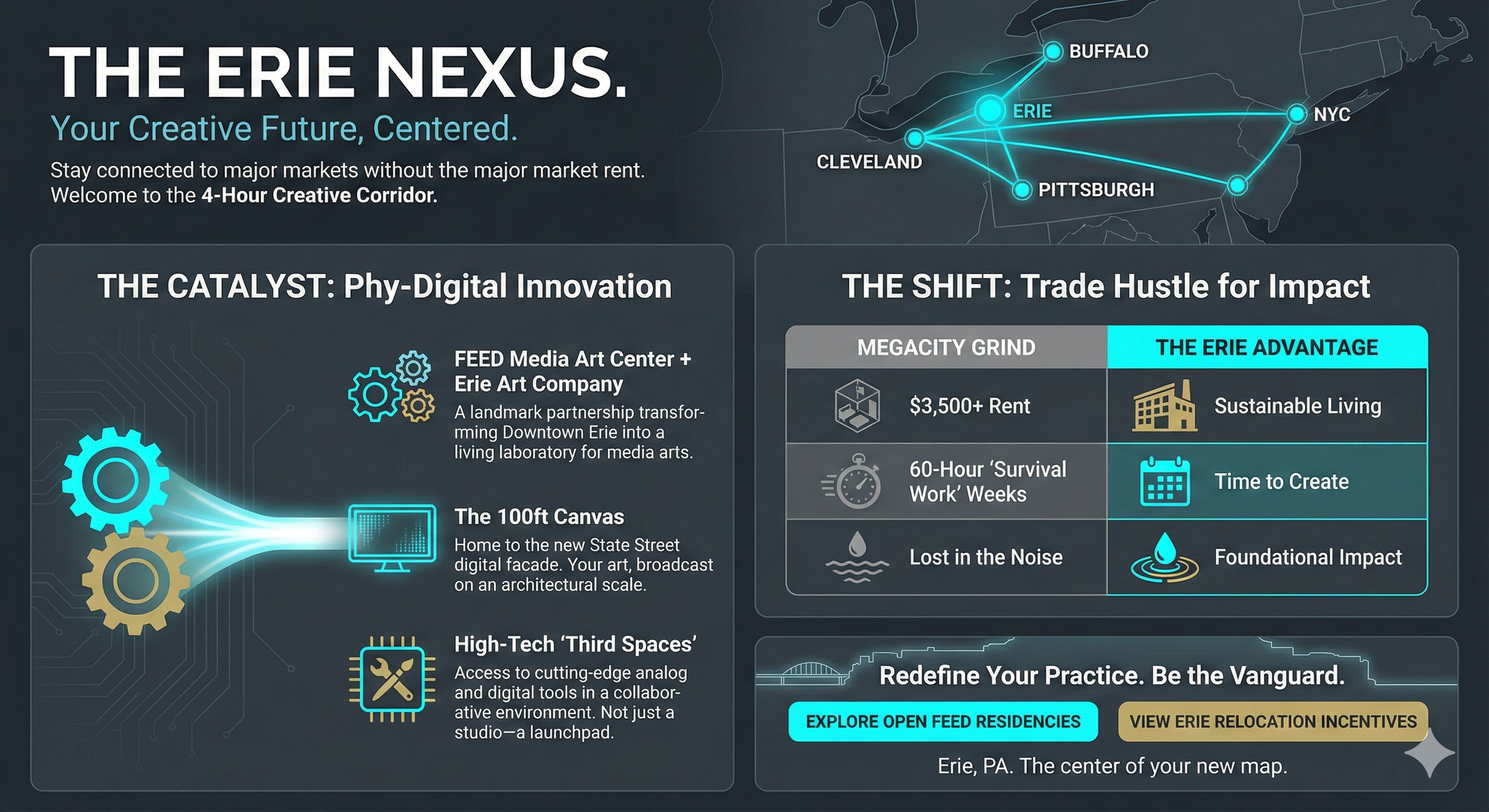
Let the artists create the path, and the entrepreneurs build the bridges that make that path a permanent highway for progress. In Erie, the map is being redrawn—not by chance, but by a community brave enough to value both the vision and the venture."
While many cities are vying for the attention of the displaced creative class, Erie, Pennsylvania, is uniquely poised to capitalize on this migration through a combination of geographical advantage and aggressive institutional partnership. Geographically, Erie serves as a vital anchor point within a four-hour "creative corridor" that connects the cultural powerhouses of New York City, Buffalo, Pittsburgh, and Cleveland. This positioning allows artists to maintain proximity to major markets and gallery circuits while benefiting from Erie’s significantly lower overhead costs. By functioning as a regional "node," Erie offers a solution to the modern artist’s dilemma: the need for global connectivity paired with the desire for a sustainable, local lifestyle.
The catalyst for Erie’s current cultural transformation is the synergistic partnership between FEED Media Art Center and Erie Art Company. This collaboration has turned downtown Erie into a laboratory for "phy-digital" innovation. In late 2025, the two organizations received a landmark $100,000 Anchor Building Grant for a "digital facelift" of their shared State Street flagship, featuring a massive 100-foot outdoor screen. This infrastructure does more than just display art; it signals a commitment to media arts and interactive technology that is often absent in larger, more traditional cities. FEED’s role as a digital arts incubator—providing studio residencies and access to specialized analog and digital tools—complements Erie Art Company’s mission to integrate public art into the city’s economic fabric. Together, they are creating a high-tech "Third Space" that acts as a magnet for creatives fleeing the sterile high-rises of Manhattan or the over-saturated markets of the West Coast.
The impact of this partnership on the "Creative Exodus" is both economic and psychological. For Pennsylvania, the success of the FEED/Erie Art Company model serves as a blueprint for statewide "Creative Districts," a program prioritized by the Commonwealth in 2025 to revitalize Rust Belt cities. By repurposing historic structures, such as the former Epp’s Furniture Store, into cutting-edge media center, Erie is demonstrating that "adaptive reuse" can be high-tech and forward-looking. As artists move to Erie to participate in programs like the OPENFEED residency, they bring a level of innovation that attracts further investment and workforce development. For the creative fleeing the megacity, Erie offers something more valuable than just a cheap studio; it offers a seat at the vanguard of a new, digitally-integrated cultural movement.
Join the movement — spark creativity and grow our community.
Works Cited"Artist Opportunities: January and February 2025." Creative Capital, 15 Dec. 2024, creative-capital.org/opportunities/2025-january-february/. Accessed 30 Dec. 2025."Guide to the Best Artist Grants and Opportunities in 2025." Artwork Archive, 20 Nov. 2025, www.artworkarchive.com/call-for-entry/complete-guide-to-2025-artist-grants-opportunities. Accessed 30 Dec. 2025."Paducah Remote Workers Incentive Program." City of Paducah Planning Department, Oct. 2025, paducahky.gov/departments/planning/remote-workers-incentive-program. Accessed 30 Dec. 2025."Tulsa Remote: 2025 Community Resources." Tulsa Remote, 12 Nov. 2025, www.tulsaremote.com/faq. Accessed 30 Dec. 2025.Bainbridge, Benton C. "Erie's Front Row – Episode 28." Erie Regional Chamber & Growth Partnership, 5 Oct. 2025."FEED Media Art Center & Erie Art Company receive $100,000 Anchor Building Grant for a 100 ft TV Screen." Erie Art Company Press Release, 3 Oct. 2025, www.feed.art/newsroom/grant-announcement. Accessed 30 Dec. 2025."Strategic Framework: Pennsylvania Creative Industries." Commonwealth of Pennsylvania, Apr. 2025, www.pa.gov/agencies/coa/about/strategic-framework. Accessed 30 Dec. 2025.Schank, Dan. "An Entire Building as an Art Project." Erie Reader, 12 Sep. 2023 (updated Nov. 2025), www.eriereader.com/article/an-entire-building-as-an-art-project. Accessed 30 Dec. 2025.